Bringing It All Together: How to Mix Music (Part 6)
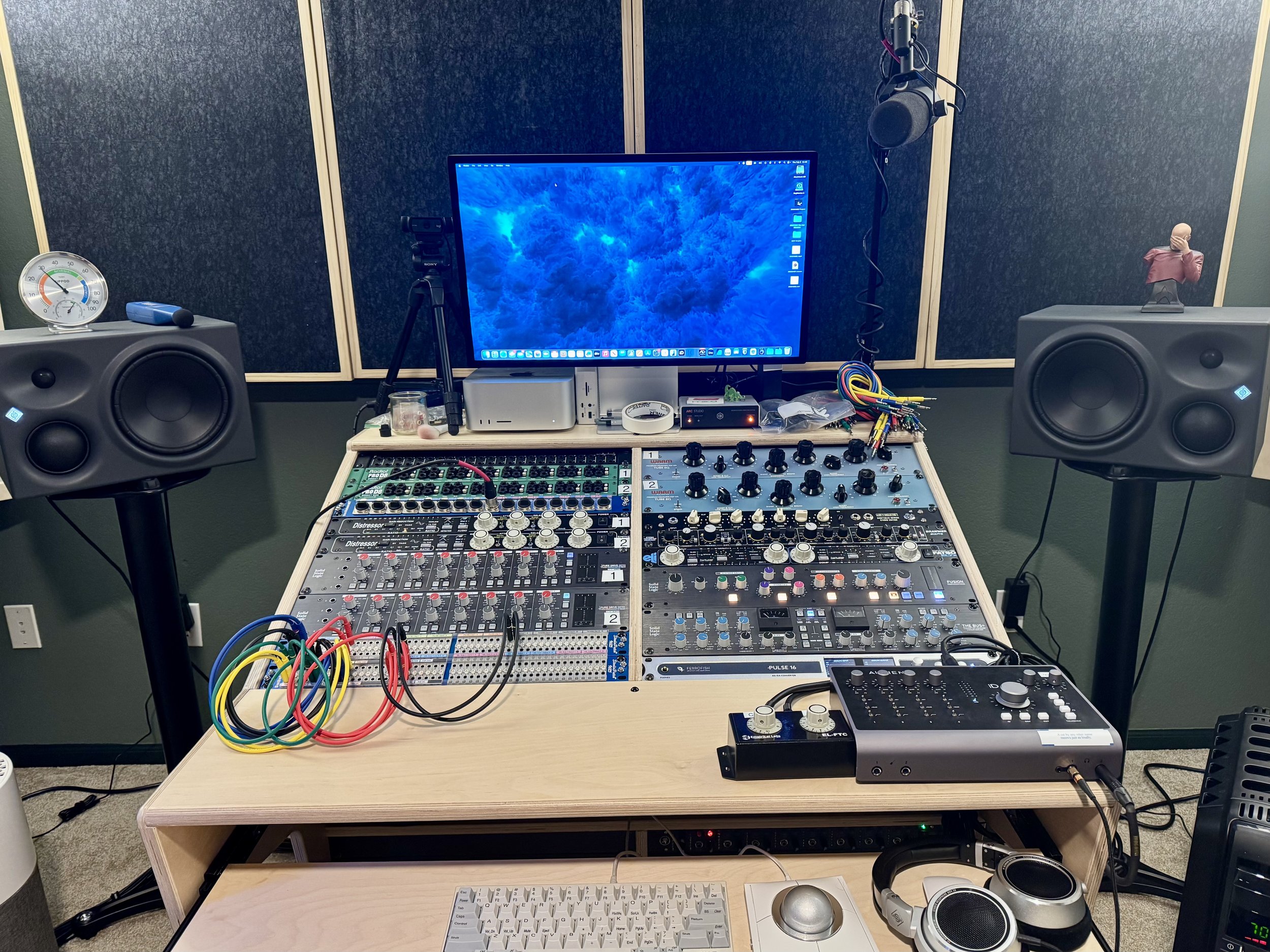
We’ve reached the end of the ride, my friends! This is part six of six in my series on mixing for novice to intermediate mixers. You've got the seat, the three legs, and now we're going to put the whole thing together and actually sit on it. If you haven’t read the first five posts, you may want to do that, starting with Mixing Is a Three-Legged Stool, which introduces the concepts we’ll use today.
In this final post, I’m going get into concrete with specific examples and practices you can start using today to get consistent sounding, professional mixes.
There are as many ways to mix a song as there are people who mix songs, and the reality is that every genre and nearly every song requires its own approach. There are many wrong ways to mix a song, but there is not a right way. There are only good ways that serve the music. And of course, mixing is both about facts and opinions, so there is room for both science and art in the process. Whether a kick drum is masking the low frequencies of a bass guitar is a fact but whether that’s a problem is an opinion.
How To Mix Music
All right, so, caveats aside, how do you mix a song? For the purposes of this post, I’m going to assume that we’re talking about something that’s, broadly speaking, a modern pop song. That means we’re going to have drums, a bass instrument, midrange instruments, and vocals. Different styles of music will require different approaches, and I’m not going to cover absolutely everything.
The second step in mixing music is project setup and layout. Effective, efficient mix engineers use templates, and you should too. You should probably make your own template too instead of relying on one you download from an engineer you respect. Their workflow will be different than yours, and your template should serve your workflow, not the other way around.
I believe in buses. I submix and bus almost everything. Submixing makes stem delivery easier, it makes delivering the Recording Academy’s recommended package of mixdowns easier. My typical submix buses are drums, additional percussion, bass, keys/synths, guitars, vocals, and other groupings of similar instruments. When I get songs with horns, those are typically on their own bus. Keys are sometimes combined with synths, sometimes not. Vocal buses are sometimes leads plus background vocals, sometimes those are separated out. Sometimes there are three vocal buses: lead vox, bgvs, and then all vox summed. You have to do what the music requires, but the point here is that creating summed submixes enables bus compression on like instruments and enables much better mix cohesion via shared reverb. If you want your music to sound like it was all performed together in a room, I believe this is crucial. Once you get the hang of it, I also think it makes mixing wildly easier and faster, especially if you’re mixing clients’ music. Rarely does someone tell me “turn lead guitar 2 down a little please,” they say, “the guitars are louder than I want,” and I can turn the whole bus down without affecting balance or cohesion.
The Mixing Order of Operations
Remember “Please excuse my dear Aunt Sally” (PEMDAS) from Algebra in middle school? There’s a similar order of operations in mixing, though it’s not nearly as rigid. In mixing, you’re going to have parentheses, or sets of operations you want to perform together, too.
A good starting point for your order of operations is this:
Clip gain / volume trim (including automation, especially on vocals)
Timing (including gating)
Tuning
Track panning
Subtractive EQ
Soft clipping
Compression
Additive EQ
Saturation
Modulation
Track delay (effect)
Track reverb (effect)
Send delay (shared space)
Send reverb (shared space)
Limiting
Track fader volume
Panning automation
Track volume automation
You don’t need to do all of those, and sometimes you don’t even need to do any of them, depending on the source material. That order of operations gets performed repeatedly along another order of operations.
Drums
Bass
Delay and reverb sends
Main melody midrange instruments
Supporting midrange instruments
Lead instruments
Vocals
Delay and reverb send fine-tuning
Stereo bus
Mix The Rhythm Section First
Almost always, I’ll start with the drums. If the drums are multitracked, then I will absolutely always start with them. I like to solo the drum bus but not the individual drums when I’m dialing in the sounds. Most of the time, I don’t mix in solo, but the drums are a consistent exception because drum tails stack and build up volume subtly, and I find it much easier to dial in gates, levels, and compression when nothing else is competing for the space. It’s important to remember that a drum set (or electronic drum machine) is one instrument that makes lots of sounds, and you need to mix it like that.
First, I dial in the kick following the order of operations above. Then, the snare and the hi hats. If the song is tom heavy, I’ll usually do kick and then toms before snare, because the low range of toms can interfere with the upper regions of a kick drum. Once I’ve dialed in kick, snare, hi hat, and toms, I move onto cymbals and other percs. Cymbals frequently need fairly aggressive gating to avoid excessive decay and energy buildup in the high frequencies.
After the drums sound like one tight instrument occupying the same space, I’ll move onto my bass instrument(s). When mixing the bass, it’s important to ensure the kick and bass (and sometimes toms) aren’t masking one another. You generally want the kick and often the bass to be in mono and both centered, so your primary means of separating them is EQ, sidechain compression, multiband (sometimes sidechain) compression, and saturation on the bass to create timbral variance. Your goal is to make them both clearly audible at low volume.
Again, drums should go on a drum bus and bass should go on a bass bus. A good clipper on the snare and again on the drum bus can be used to eliminate excessive transient spikes before compression. Listen closely, and you can often remove several decibels of volume from the drum transients without audibly changing the sound. By removing several dB from the transients, you can ask your compressor to do less work, which will usually result in a dramatically more transparent function. A low ratio (2:1 through 4:1), gentle compressor on the drum bus will glue the drums together.
Once you’ve nailed the rhythm section’s mix, you should feel like you have a solid foundation for the song. The drums and bass should play well together and typically be listenable on their own. Before you move on, make certain that you can clearly hear all the voices that are playing and keep an eye on your gain staging. I typically aim for buses to hover around -9 dB when summed to ensure headroom on the 2-bus.
Set Up Delay and Reverb Sends
For the purpose of this guide, we're going to use delay and reverb sends to create a sense of shared space that makes a song feel more like it's been performed live in a room. Set up two send channels, one for delay, one for reverb. Effects on both channels should be 100% wet. We're going to build the classic, "correct" physical model for this.
We're going to build the delay send first. Sound travels at roughly a foot per millisecond. Technically it's 1.1 ms per foot, but that's not terrifically important here. Set up your delay in mono, again, 100% wet, with a delay of about 15-50 ms. If you stay under 30 ms delay, you'll trigger the Haas Effect, which will make listeners perceive space, not echo. Ensure that this delay is not tempo-synched. Keep the feedback low (10-25%), and set up three taps. You could do 18 ms, 27 ms, and 35 ms for instance, which will simulate the sound bouncing off three walls. You'll want to EQ the highs, probably between 5 kHz and 8 kHz to simulate the absorption effect of the walls, and then cut in the 150 Hz range to eliminate muddy buildup.
Next, we're going to set up the reverb send. This one can be stereo or mono, your choice. I typically prefer stereo. We want to set the pre-delay to 0. Consider the room size you want to place your song in, and remember that sound travels at a foot per millisecond. If you want a small to medium room, you want a setting in the neighborhood of 0.5 seconds for your reverb. Turn off early reflections and perform the same EQ cuts on the reverb.
Then send the delay into the reverb. Use your ears to get to a level you like — the reverb should be quieter than the delay, so oftentimes I'll wind up sending delay at -18 dB to -6 dB into the reverb. After that, add an EQ at the end of the chain to high-pass everything below about 120 Hz, keeping the low end of your mix tight and mono. Finally, add a width plugin after the EQ. Use it to collapse the lows to mono (again, around 120 Hz and below) and to open up the mids and highs in the sides. This is what gives the shared space air and dimension without creating a muddy, phase-incoherent low end.
Now, it's worth noting that some reverbs realistically simulate rooms without the need of a dedicated delay. If the one you want to use does, then you can skip the delay, but many basic reverbs don't handle realism well, so it's worth understanding the principles so you can do this yourself.
In this two-send approach, you would send your instruments and busses only into the delay, never directly into the reverb. If you want to create realism, don't send your tracks directly into both.
I find it best to set the space for the song after the rhythm section is done. You may find yourself coming back to fine tune it, but remember: be restrained in what you send to this chain. You're looking for realism, not an effect. Often, I find that I want to high-pass the signal from the drum bus and the bass bus before sending into my spatial effects — low frequencies fed into a delay or reverb generate upper order harmonics that add mud and smear to the chain that the high-pass on the send bus itself won't catch.
Mix The Midrange Instruments, Then The Leads
Typically, this will be synths, pianos, guitars, horns, and so on, depending on your genre.
To nail the midrange, you need to be sure of your own mixing philosophy, or at least the philosophy you’re going to use for the song you’re mixing. Are you a believer in subliminal ear candy or do you fall more in line with the philosophy of Martin Atkins, who has famously (and repeatedly) extolled the mantra, “Feature it or f$%# it?” I am far more aligned with Mr. Atkins’s approach, and so that is the perspective from which I’m writing this post. For my clients, of course I’ll mix their songs in the way they want, to bring out the vision they have for their music. But I’ll also dip into producer territory and ask questions like, “is this element of the song really additive?” Sometimes, the best and easiest way to mix a track in a song is to mute it and skip the audio gymnastics required to make that sound matter.
As producer and educator Colt Capperrune has said, the “magic is in the midrange,” and it’s true. Human hearing is best-attuned for this frequency band, and people pay close attention to it. It’s also the part of your mix that nearly every speaker will reproduce clearly. Many speakers don’t reproduce bass or high frequencies well, but nearly all of them can do the midrange, so it’s critically important that you sweat the details here.
A general rule of thumb that I follow is that the more dynamic and pristine a sound is (think a nylon string classical guitar, a flute, a violin, etc.), the less compression you can apply to it without changing its character. On the other hand, the more harmonically dense a sound is, the more it can be compressed without being ruined. Unless you are going for compression as effect, less is nearly always better. When I have multiple instruments playing together and carrying the main body of the song, I start with the ones whose dynamics I must control the most and work to those whose dynamics I may control the least. Remember that what makes an instrument sound loud is its volume relative to the others. If you want the violin louder than the electric guitar, it’s often better to turn the guitar down.
If you haven’t (recently) read my post on volume in mixing, it may be worth a few minutes to go back to that post. The real “trick,” if there is one at all, to mixing the often-dense midrange melodic components of songs is deep understanding of your tools. Set for yourself a clear vision of what you’re trying to achieve and work with the fewest number of tools necessary to achieve that outcome. And remember: think in buses. You’re creating a submixed collection of sounds that work together.
Once you have the general balance right, work to automate the volume of the instruments in the bus. When one takes the compositional lead, bring it out and push the others a little to the back. Remember to use the stereo field you have available to you to give breathing room to each of the instruments. If you find that there’s just not enough room for things to fit, this is when you have to consider going back to the arrangement to remove elements. Or, if you’re mixing for a client, you owe it to them to pop on your producer hat and make your best suggestion to serve the needs of the song. Remember: the mix is the technical work needed to serve the artistic vision of the song.
Once you have the main midrange melodic instruments and supporting instruments working, move onto the lead lines. Lead lines deserve special focus, and that often means that they need to be front and center. However, that’s not a hard and fast rule, and you can use the stereo field to great effect. Creating a left and right call and response, for instance, can be more effective than driving a guitar solo right down the middle.
Mix The Vocals
There’s no sugar-coating it. Mixing vocals is hard. Singers have extremely strong opinions about their voices (and many are uncomfortable with how they sound on record) and listeners have extremely strong opinions about how voices sound. Singers’ microphone technique often leaves something to be desired, and in 2026, vocal tuning and timing editing is the rule, not the exception.
For the purposes of this post, we’re going to stick to the lead vocal. The first thing I handle is pitch correction if needed (it is almost always needed). I try to keep it gentle and realistic, helping the singer through bumpy parts, but not acting as a cheat code if possible. Using Auto-Tune Pro with gentle correction is my preference, but correcting by hand using Melodyne or another similar tool is sometimes necessary, but I often believe it reduces the authenticity of the vocal performance.
After tuning, I work on timing. Generally speaking, you want the phrasing to be on time, but not robotic. If you want to build energy and intensity, vocals coming a little before the beat, pushing things along works well. If you want a relaxed vibe, have them landing a little bit after the beat. Varying vocal delivery timing can be used to great effect when you’re trying to build up energy in a particularly anthemic chorus or other part of the song where you want the listener to want to sing along.
The next thing I do is volume trim or clip gain automation of the vocal. For particularly dynamic singers or singers who vary their distance from the microphone, editing the levels of the performance either by hand or using Waves Vocal Rider is a necessity. I like to err on the side of raising the level of quiet parts rather than lowering the level of loud parts when doing this. Once I’m satisfied with the general consistency of the levels, I remove harsh or sibilant tones, perform de-essing, and any other corrective EQ that I believe the vocal needs.
The sound of modern vocals is the sound of compression, and novice mix engineers often miss the sweet spot between too much and not enough compression, largely, I expect, because they did not sufficiently adjust the clip gain prior to compression. My mantra for vocal compression is that “I only want the dynamics that serve the song.” Listeners want to hear the singer clearly throughout the whole song. They also want the volume of the song to remain reasonably consistent. If you’re constantly having to turn the volume of the instrumental up and down to make space for a vocal that dips in volume, the vocal isn’t finished. Maybe it needs re-recording or maybe it needs more editing, but in any event, you want the vocal to be dynamic only inasmuch as those dynamics serve the song.
In keeping with the standard order of operations, I prefer to add saturation to the vocal after compression, not before. However, with vocals, I tend to treat the guideline a little more seriously. Because of the clip gain, tuning, timing, and EQ, adding saturation to the vocal prior to compression can often produce unexpected and poor results. Not always the case, so you should experiment with the vocal you have at hand, but most of the time, I find saturation works best after the compression, and often makes the vocal feel more alive and authentic. And, because people are very attuned to the way their voices sound, I have found that saturating prior to compression is likely to make someone tell me that something sounds off in the vocal.
Once you move through the rest of the order of operations, you may find you need to go back to some of your instrument buses and create a little space with EQ or multiband compression so that the vocal isn’t getting buried. After the vocal sits in the mix with the rest of the instruments, dial in its spatial send. You may want to push it a little harder into the spatial send than other instruments, but, as always, use your ears.
Revisit Delay And Reverb, Then Go To The Master
Now that your whole song is going to your spatial bus, you may want to make some tweaks to it. You want the level of the delay and reverb sends to be pretty low. You should miss them when they’re gone but not really notice them when they’re present. You’re going for realism and space, not a wild effect.
Finally, address your master channel. Depending on what you’re doing with the song next, what roles you’re playing, etc., you may not want to do much or anything to it or you may want to do a lot to it. If you have a master chain you love to use, then doing the stereo bus first and mixing into it is usually for the best. But if you’re not going to do that, I like to save this for last.
Compression on the master should typically be fairly gentle and low-ratio. You’re working to control dynamics a bit and glue everything together so that it sounds like a song, not just like a bunch of sounds playing together.
At this point, you’re working to create balance in the song. I love to use mid-side EQ on the master to mono the bass (typically everything around 120 Hz and below), tame 4 kHz harshness that often builds up, and boost the upper mids in the sides to build a sense of space and air.
If your song sounds a little lifeless, adding some gentle saturation (usually targeting around 1% total harmonic distortion, or THD) is valuable. You may also find that a clipper is useful early on in your plugin chain to eliminate transient buildup that often occurs. Remember that audio levels are additive, and if you have three or four buses, each playing a note with some strong attack on the 1 of every measure, you’re getting a lot of level buildup, and you may be able to cut out several decibels without changing the sound in a way that anyone can hear. And, again, that makes your compressor and limiter do less work.
Conclusion
And there it is! The whole, uh… stool (or mix), fully assembled. Every decision we've talked about in this post, every bus, every plugin, every step in the order of operations, is just volume, space, and timbre working together in service of the music. The tools change, the genre changes, the song changes, but those three legs never do.
There are no rules to making a great mix, and no process will work reliably every time. But if you've followed this series, you now have a structured, repeatable workflow and the conceptual framework to understand why it works, which means you also have the tools to know when to break it.
Now go make something great. And if you'd rather hand it off to someone who loves this stuff, you know where to find me.